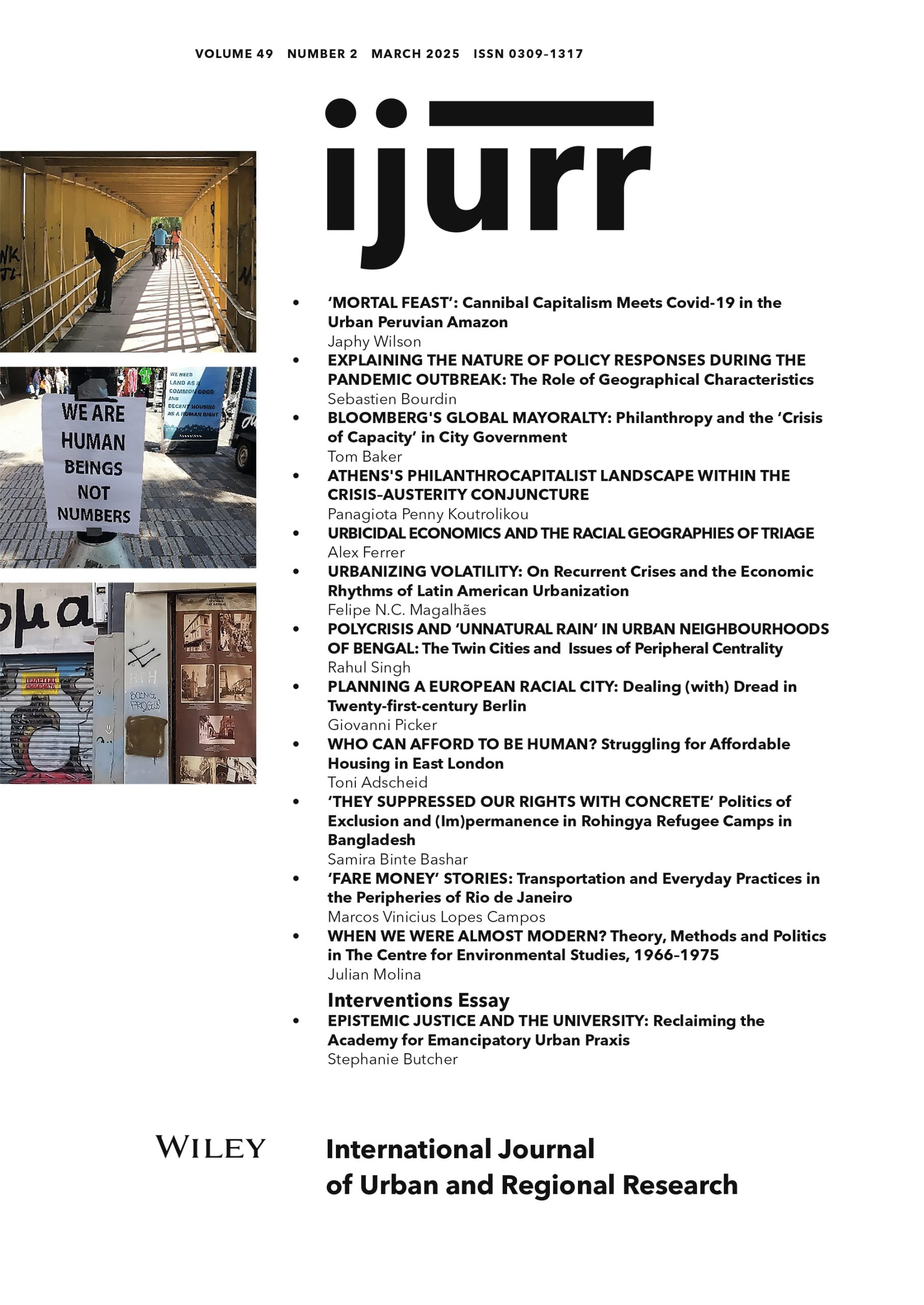

The hegemony of neoliberal and austerity policies, which became further entrenched within the continuum of crises unfolding in the past 30 years, has provided ample opportunities for corporate actors and foundations to gain an increasingly decisive role in aspects of social and political life and governance. In several crisis-afflicted cities, local and global philanthropic and philanthrocapitalist foundations became key stakeholders in urban development and governance, as well as in restructuring the terrain of urban policies and decision making. This article explores the growing influence that philanthrocapitalist foundations have acquired in the city of Athens in the past 15 years of entangled crises. By focusing on urban projects leveraged or implemented by these foundations in Athens, we trace the philanthrocapitalist urban landscape of the city and explore the transformations it prompts, not only in the ‘image of the city’, but also in urban governance and urban and political imaginaries. This emerging urban landscape is diverse and multiscalar, consisting of interventions in urban governance, developing or promoting landmark projects and implementing a multitude of small-scale projects dispersed over neighbourhoods. It reflects the omnipresence of philanthrocapitalism in the city’s affairs and raises questions about the impact that this recent transformation might have.
The IJURR Editorial Board have voted this as a highly commended article in 2025:
Focusing on Athens over fifteen years of entangled financial, humanitarian, and austerity crises, this article maps an emergent “philanthrocapitalist urban landscape” in which large foundations and corporate donors shape urban governance, landmark cultural projects, and a dispersed array of neighbourhood‑scale interventions. Through critical policy and discourse analysis, the authors show how entities such as the Onassis and Niarchos Foundations, Bloomberg‑linked governance innovations like Athens Partnership, and programmes such as “Adopt your City” reconfigure decision‑making, redistribute symbolic and material power, and normalize private influence over public space, raising urgent questions about democracy, urban justice, and the future of collective urbanism.