
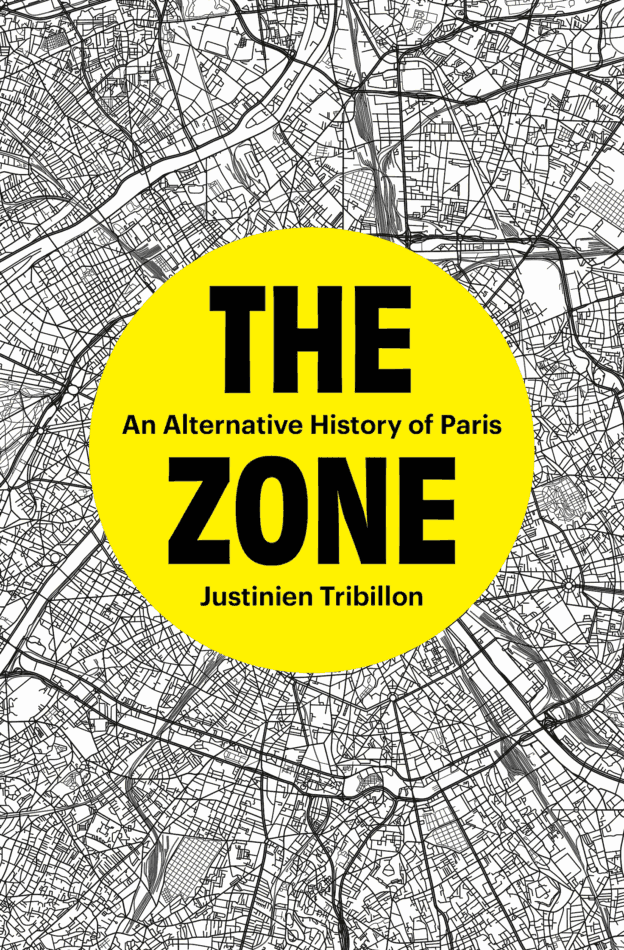
Justinien Tribillon’s The Zone: An Alternative History of Paris is based on many years of research, including the innovative use of walking methodologies, archives, interviews, photography and diverse ethnographic insights. The book is framed by what Tribillon terms ‘the Zone’, a forbidding technological cordon sanitaire that separates the central core of Paris—some 2.5 million people—from the surrounding suburbs or banlieue, with some 10 million inhabitants, predominantly comprising working-class people and immigrants. So stark is this contextual denigration, notes Tribillon, that examples of modernist architecture that might be despised in the banlieue are often the focus of sustained care and attention within central Paris.
Tribillon places the contemporary bifurcation of Paris in its historical context, highlighting the spatial legacy of the Haussmann era in relation to centralization, rationalization and social control, and a concomitant intensification in hygienist discourses on race, ethnicity and cultural difference. He reveals how specific forms of socio-spatial stigmatization have been a marker of Parisian modernity from the outset, as illustrated by tensions between the rival planning visions for Paris, articulated in particular by the modernist visionary Eugène Henard and the reactionary conservative Louis Dausset. In the final analysis, however, Tribillon suggests that Henard’s ostensibly more egalitarian vision was actually underpinned by the needs of real estate. Notably, Tribillon reveals the persistent influence of colonial thinking on urban planning, sometimes involving the same figures engaged in experimental forms of spatial rationalization and social pacification both in metropolitan France and in the colonies.
Infrastructure often serves as a symbolic marker for urban space, especially in the form of physical barriers or securitized zones, thereby re-inscribing or even producing forms of social inequality. Tribillon (p. 6) shows how the Parisian ring road, the post-war Boulevard Péripherique, completed in 1973, became a dividing line between two very different socio-political formations, serving as a kind of material and symbolic barrier between the inner and outer city, producing ‘a stark spatial demarcation between the “in” and the “out”, the “us” and the “them”, Paris and the Other’. ‘Made of ink and administrative correspondence as much as concrete and steel rods’, notes Tribillon (p. 108), ‘the ring road is the result of a complex design process that apprehended the city of Paris as an abstract, highly malleable matter …’. Furthermore, the design of the new boulevard incorporated various kinds of landscaping features, including the extensive planting of trees, so that the ring road has more recently been appropriated into plans to transform the so-called ‘dirt belt’ into a new ‘green belt’, as part of a wider kind of transformation of urban politics into what we term ecological revanchism. In spite of all these new initiatives, however, Tribillon (p. 193) argues that ‘the Zone will not disappear. The belts of Paris will not disappear. Because the social and political matrix of the city, its deep infrastructure, will not change’.
Like Susan Buck-Morss, Tribillon illuminates how technocratic utopian visions have flourished under markedly different political systems. Tribillon shows how the technocratic ideology underpinning the Boulevard Péripherique spans its conception under the Vichy regime (1940–44), approval under the Fourth Republic (1946–1958), and construction under the Fifth Republic from 1958. With the fading of technocratic planning ideology, however, the real impact of the ring road has become a focus of sustained critical scrutiny. Tribillon explains, for example, how the impact of noise gradually shifted from being a peripheral grassroots concern to a well-organized domain of technical expertise that could challenge the epistemological hegemony of engineering, along with other more recent campaigns devoted to the health-threatening impacts of air pollution.
The Zone is an exceptionally interesting book that is brimming with conceptual and political insights. Tribillon’s vibrant and engaging prose will appeal to a wide readership, bringing a new level of intellectual scrutiny to the divisive legacies of technocratic urban planning in European cities. Towards the close of the book Tribillon (p. 182) leaves us with the trenchant observation that: ‘The structural inequalities, intimately connected to urban planning, architecture, and France’s colonial past, that constitute the space of today’s Paris, are permanent, discreet but extremely powerful expressions of racial violence’.
Matthew Gandy, University of Cambridge
Justinien Tribillon 2024: The Zone: An Alternative History of Paris. London, Verso
Views expressed in this section are independent and do not represent the opinion of the editors.