
We know that the far right is about space. Nazis claimed racialized living space (Lebensraum). In turn, anti-fascists call their approach territorial (un anti-fascisme de terrain in French). But what kind of ‘space’ are we talking about? The authors collective Terra-R offers us answers to this question. Writing in and about Germany, its members take a broadly constructivist approach and exhort us to put ‘an end’ (das Ende) to naturalistic conceptions of ‘right-wing spaces’ (rechte Räume). Instead of assuming that some geographies ‘belong’ to the right because their supposedly obvious and innate characteristics (naturality, suburbanity, rurality, peripherality, East Germanness) predestine them to become ‘brown’ (go Nazi), they urge us to study the processes through which the far right generates social space. As they say:
Das Ende rechter Räume verstehen wir als Plädoyer für die kritisch-transformative Auseinandersetzung mit rechten Hegemoniebestrebungen und ihren Raumnahmeversuchen. Zugleich wenden wir uns gegen populär-räumlich Betrachtungen, die rechte politische Verhältnisse aus dem Wesenskern von Räumen erklären. (p. 16)
[We consider Das Ende rechter Räume to be a plea to engage right-wing hegemonic aspirations and claims to space in critical and transformative ways. At the same time, we argue against a populistic spatial view that explains right-wing realities with reference to the supposed inner essence of spaces.]
To denaturalize right-wing geographies by treating them as products of history is both a scientific and a political imperative. Doing analytical justice to the complex dynamics of far-right geographies doubles as a weapon to destabilize the ‘ground’ on which the far right stands.
To understand the production of right-wing space, Terra-R work with two theoretical constellations on territorialization. As we learn in chapter 2, the first is informed by Euro-American theories of territory as developed in Marxian or Foucauldian traditions. In this radical geographic tradition, territory is capitalist state space: abstract, bordered and homogenous. The second centres on Latin American theories of territorio (Spanish) or território (Portuguese), as something Indigenous, feminist or decolonial. Here, territory is the result of embodied daily practice: material, affective and semiotic. The authors embrace the theoretical links and tensions between these theoretical complexes without resolving them (p. 44):
Wie wir auf den nächsten Seiten ausführen, verstehen wir territorio und territory dabei weniger als trennscharf unterscheidbar, sondern als historisch, geographisch und politisch je spezifisch situierte Konzepte, die jeweils bestimmte Aspekte von radikal rechter Raumproduktion sichtbar machen—auch wenn es zahlreiche Verbindungen zwischen beiden Konzepten gibt. (p. 34)
[As we set out in the subsequent pages, we understand territorio and territory not as neatly distinguishable but as concepts that are historically, geographically and politically situated in specific ways; each renders visible particular aspects of radical right productions of space—even if there are numerous connections between the two concepts.]
Terra-R suggest that the two concepts highlight the tension-filled relationship between key agents of right-leaning territorialization. If institutional actors generate territory in a conventional, state-bound fashion, the far right produces corporeal territories (territorios) through movement practices (albeit not in the emancipatory ways intended by territorio theorists).
For Terra-R, central to the story is the ‘radical right’, a ‘spectrum of actors’ (p. 22) that range from right populists to neo-Nazis. The book focuses above all on the territorialization by the radical right (Territorialisierung von seiten der Rechten). However, the authors relate the radical right to actors at the heart of liberal democracy and the capitalist state. They ask how journalists, police forces and mainstream politicians generate processes that echo, qualify or relay the territorialization of the radical right itself (Territorialisierung bezüglich der Rechten).
Zwar mögen oben genannte Territorialisierungen von den Rechten als Form der Gegenmacht verstanden werden, doch sind sie zugleich immer eingebettet und ermöglicht durch staatliche Zugriffe oder eben deren Fehlen. So mögen rechte Territorialisierungen teils eher von institutionellen Arrangements oder rassistischen und fremdenfeindlichen Konjunkturen als von rechten Handlungsstrategien getragen werden, ebenso wie Elemente rechter Territorialisierung unerwartete Prozesse in Gang setzen und von anderen Akteur*innen auf neue Weise aufgegriffen oder zurückgedrängt werden können. (p. 47)
[While the right considers the aforementioned forms of territorialization as a type of counter power, they are always simultaneously embedded and facilitated by the presence or absence of state intervention. Right wing territorialization may be sustained more by institutional arrangements or racist or xenophobic conjunctures than by right-wing courses of action; in turn, elements of right-wing territorialization can put in motion unexpected processes and be taken up in new ways or pushed back by other actors.]
The authors’ two-sided research focus usefully retains crucial insights from the historiography of the far right, including fascism. While the far right is rarely a mere instrument in the hands of the bourgeoisie, its expansion is impossible to understand without taking into account how it relates to state and bourgeoisie through dynamic and tension-ridden relationships of competition, collusion and collaboration. In spatial terms, the far right never territorializes in isolation from actors and institutions in liberal capitalist society.
The core chapters of the book offer a well-conceptualized and well-illustrated tableau of four dimensions of far-right territorialization. Chapter 3 focuses on material-corporeal, ’performative’ forms of territorialization that occupy, mark and delimit physical space. Two political repertoires serve as examples: Montagsspaziergänge [Monday walks] developed first during the Islamophobic Pegida protests and subsequent mobilizations against public health measures during the pandemic, and online propaganda by Kameradschaften [identitarian leagues] that spread images of far-right spatial practices and connect a masculinist body culture to nationalist ideals of ‘natural’ and ‘rural’ landscapes. Focused on affective territorialization processes, chapter 4 shows how far-right magazines and political discourse evoke emotive atmospheres, ‘structures of feeling’ (Raymond Williams) that can generate a sense of belonging through fear and hate (of others) or pride and love (for the in-group). Relatedly, chapter 4 focuses on the production of imaginary territorializations by far-right media and mainstream sources (crime statistics, policy reports and journalism). The emphasis here is on the production of Feindbilder [enemy images] that help the far right identify targets to harass and terrorize: enemy spaces (cosmopolitan urban life, migrant-identified streets, and consumption spaces like shisha bars) and enemy bodies (notably migrants and non-White Germans). Finally, chapter 5 focuses on infrastructural territorialization, the production of physical and organizational spaces (editorial offices, meeting rooms, bars, stores) through which to organize and mount a public presence.
Das Ende rechter Räume makes a powerful contribution to a growing multilingual literature on the political geographies of the far right, fascism and authoritarianism. It is also highly pertinent for those interested in anti-fascist praxis (my terminology, not the authors’). As I mentioned initially, the most important critical contribution the volume makes is its method of denaturalization. This method is complemented by two chapters devoted to the pitfalls of researching the far right. While focused on the far right and their relationship to the political mainstream, the core chapters give repeated insights into how opponents of the far right territorialize. Examples include efforts to ’pull the plug’ (den Stecker ziehen) on far-right infrastructures; counter-imaginaries that invest ‘enemy spaces’ with contrary connotations of solidarity and struggle; an affective politics of memory that makes isolated experiences of fear and loss on the part of the targets of far-right violence collective, public and political; and, finally, tried-and-trusted strategies of confronting and pre-empting far-right corporeal-territorial presence with counter-mobilizations and counter-propaganda. As two Terra-R authors clarify elsewhere, these examples offer glimpses into the qualitative differences between far-right and emancipatory—open-ended, convivial, democratic—modalities of producing territory.
In three chapter-length interviews, the engaged perspective of the Terra-R project becomes particularly evident. Chapter 9 elaborates the territorio approach with the help of representatives of the Colectivo Miradas Feministas and the Colectivo de Geografica Crítica de Ecuador. Chapter 8 clarifies the difference between Terra-R’s generally locally focused and micro-level approach and the Zetkin Collective’s macro-level take on fossil fascism. And chapter 7 facilitates a conversation between activists in two very different localities: central Dortmund (a city with long left and anti-fascist histories and attendant movement spaces) and a village outside Jena bereft of such histories and spaces. Village organizers report that:
Wir versuchen generell, einen Raum zu schaffen, wo viele Leute hinkommen, und wollen ihn nicht in der klassischen Ästhetik eines Autonomen Zentrums gestalten (p. 168).
[In general, we want to create a space that many people come to and don’t want to design it in the classic aesthetic style of an autonomous centre.]
The comparison between these two sites highlights the uneven development of the far right and opposition to it. It acknowledges not only that contestation matters to far-right and state-bound territorialization (p. 47). It also suggests the need to situate anti-fascist strategies within comparatively varied political histories. While strategies to confront and isolate far-right organizing can work well where the far right has not yet taken root, such strategies are more difficult to pursue where the far right has successfully territorialized, or, indeed, where it has become normalized electorally even without a significant street-level presence. In such cases, successful anti-fascist organizing may be conditional on a capacity to (re)build forms of public sociability open enough for democratic discourse before it is too late.
Stefan Kipfer, York University, Toronto
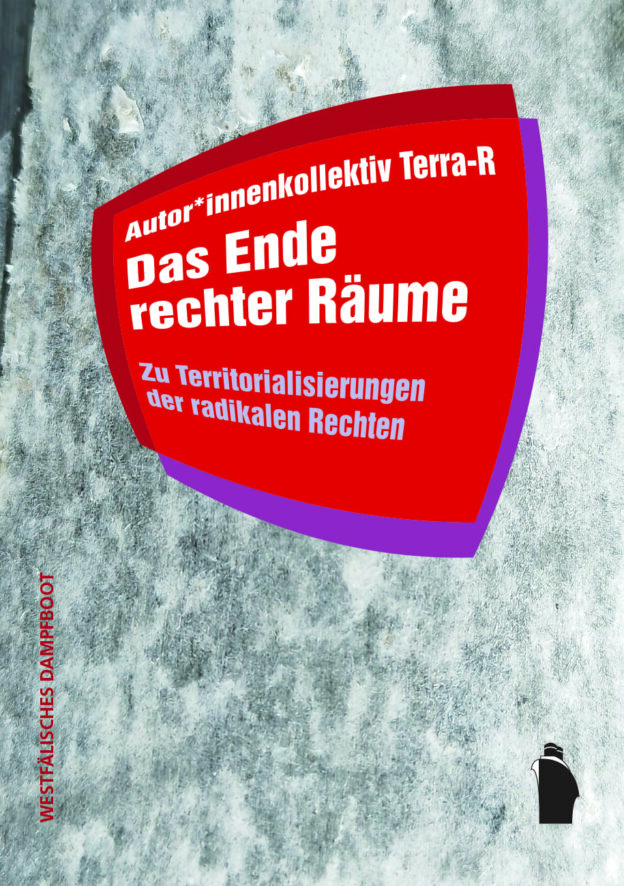
Autor*innenkollektiv Terra-R 2025: Das Ende rechter Räume. Zu Territorialisierungen der radikalen Rechten [The End of Right-Wing Spaces. On Territorializations of the Radical Right]. Münster: Westfälisches Dampfboot.
Views expressed in this section are independent and do not represent the opinion of the editors.