
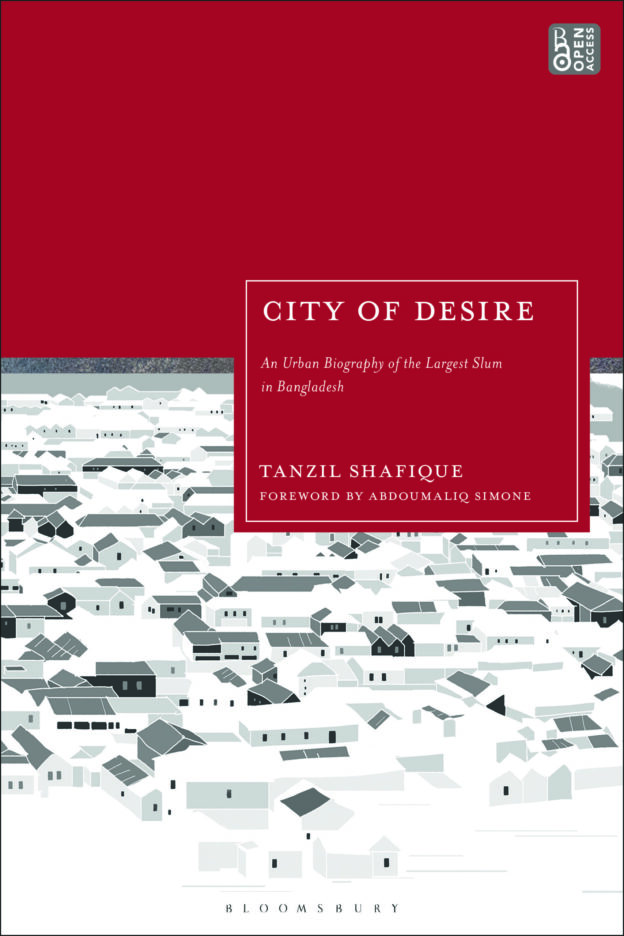
Tanzil Shafique’s City of Desire is a collection of essays that dispel any foundational claims on capitalist urbanization processes. Who is ‘the capitalist’? Who is ‘the helper’? What is ‘the capital’? What is ‘the land’? Through the origin story of Korail, the largest slum in Bangladesh, Shafique draws readers’ attention to what truly fuels a city and its peripheral surrounds: its people and their desires.
Who is ‘the capitalist’? Korail originates from the land ‘in waiting’, held up in court while the government failed to return it back to its original owners. ‘The meantime’ is a resource for those whose desire is to survive ‘the now’. As trails of dwellers started occupying the abandoned land, the ‘informal’ land tenure arrangements became possible with a network of roles that they require, or the individuals who were willing to play those roles (p. 38): the pioneer-settlers, subsistence-dwellers, entrepreneurial landholders, grabber-developers, legitimators (e.g. local mosque or bazaar committee heads), financiers (e.g. local committees funded by large non-profit organizations), supplier-sellers (e.g. arranging building materials), designer-builders and the service profiteers (e.g. water or electricity network arrangers). Amidst it all, it is difficult, or even impossible, to discern who is ‘the capitalist’ that seeks profit above everything else. The individuals who make the settlement in Korail possible, despite their ‘participation’ in the marketization of its land, are entangled with other desires: to be socially accepted and respected (p. 76).
Who is ‘the helper’? People’s power is not equally distributed; there are always local politics involved. While ‘international development’ agencies collaborate with local NGOs in their best intention to help the poor, Shafique reminds us how their efforts never unfold in a vacuum: larger NGOs, despite their substantial contribution in building social legitimacy of Korail, operate under the existing power dynamics and clientelist relations, where individuals with more social recognition rig the game in favour of their close circles (p. 52). Pouring money into the construction of physical infrastructure alone will not guarantee it will function. The case in point is the failed water infrastructure funded by global development programmes: the water does not flow where new pipes exist (p. 49). Without the social arrangements that are distinctively local, in partnership with those that can persuade service-profiteers to diversify its water market, the resource does not flow where it should.
What is ‘the capital’? This brings us down to the question of what is ‘the capital’, or the resource that stimulates Korail to function and grow. The flows of international money are definitely one, where NGOs’ microfinancing’ programmes end up funding more land development projects mobilized by mom-and-pop rentiers: ‘The loan was diverted informally towards the housing market, expanding and densifying the houses and landholders renting them out to pay the instalments … The recent densification in Korail in the last ten years seems to be tied with the flow of capital from microfinance loans’ (p. 53). But the key difference between entrepreneurial landholders and grabber-landholders is whether the landholders themselves are physical neighbours to their renters. In the customary management of collective living in Korail, one’s physical presence is an invaluable resource. In order to eventually gain ‘landholder’ status, new transplants must do their time, evidencing their desire to stay in Korail. The power, or resource-ness, of physical presence is demonstrated most powerfully in Shafique’s description of the Koralians’ silent protest (p. 43–44).
In 2012, more than 2000 households were evicted within a few hours’ notice. … [O]verall 20,000 populations have been displaced from their shelters. … The following day after the eviction, something remarkable happened. People from Korail did something unusual. They didn’t show up for work: the factories, the homes, the workshops, the rickshaws. They blocked the main streets around the city in protest, but they refrained from a violent demonstration (p. 43).
As Shafique quotes Hannan, the community leader who mobilized the crowd: ‘We just couldn’t take it. We went from house to house, shop to shop. We asked everyone to close everything, we asked people not to go to work… We assembled 100,000 people. There was no violence. … We serve the city, so acknowledge us’ (p. 44). Behind the fluid movement of the capital are the individuals and their ‘manpower’, which not only consists of physical labour itself but also of their presence as witnesses.
What is ‘the land’? A somewhat comical, but equally insightful, scene appears in City of Desire, as Shafique describes ‘speculative land-filling’ in Korail. While the government dreams of a ‘waterfront’-inspired urban renewal near the lake, the dwellers of Korail dream of its water being filled with rubbish. As Shafique puts it: ‘One of the most ubiquitous urban transformation operations underway in Korail is the filling up of the lake. Like death by a thousand cuts, the lake reclamation happened incrementally, bag by bag’ (p. 78). The edges of Korail’s lake are now completely filled with waste, producing a land-in-waiting for new residents to show up, occupy and grow roots beneath it. Shafique notes how the physical materiality of ‘land’, whatever it is made of, means much more to Korailians than its ability to generate new income. The ‘contact with the ground’—confirmed by the existence of a tree—is one of the main desires of landless Koralians wishing to secure a social grounding, which pushes the boundaries of the peripheral urban.
Challenging the narrative of ‘the slums’ as a collection of nameless ‘poor’, City of Desire, above all, reminds us that the directionality of urban expansion is not as straightforward as the ‘capitalist expansion’. Is it the capital’s profit-led motif that drives urban expansion, or is it the desires of the local population that propel the growth of urban areas? The book’s humanist message—that it is the people who make the capital flow, not the other way around—will resonate not only with scholars studying ‘informal’ settlement communities, but also with those who seek alternative imaginations of ‘urban development’. Grounded in situated, material vulnerability and responsibility, the book’s quest for a ‘just city’ is as pragmatic as it is critical against the status quo.
Ihnji Jon, Cardiff University
Tanzil Shafique 2025: City of Desire: An Urban Biography of the Largest Slum in Bangladesh. London: Bloomsbury.
Views expressed in this section are independent and do not represent the opinion of the editors.