
In January 2018 (Volume 42.1) and January 2021 (Volume 45.1), IJURR published a series of essays critically exploring how to ‘bring’ the work of Pierre Bourdieu ‘to town’. Organized by Mike Savage and Loïc Wacquant, these contributions shared a commitment to engaging with Bourdieu in a way that went beyond merely invoking terms such as ‘cultural capital’ or ‘habitus’. Instead, they called for a deeper, more serious engagement with the full spectrum of Bourdieu’s concepts. As Wacquant provocatively put it, ‘[C]ountless authors paint their inquiries in the colour of Bourdieu, when in reality his notions play no role in their analysis. The words are there, but the concepts are not.’¹
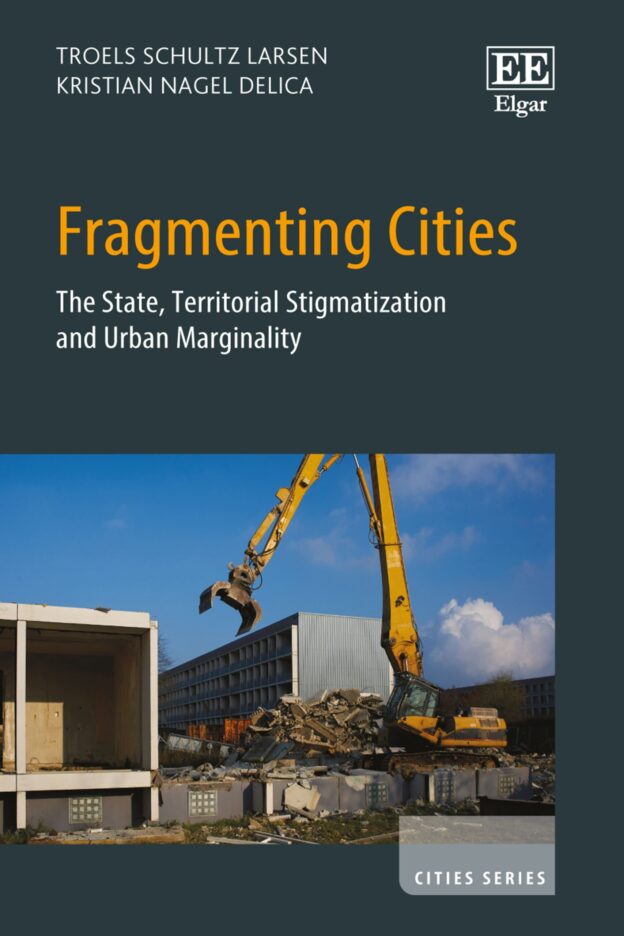
Since then, a number of studies have further explored what it means to mobilize Bourdieu’s powerful repertoire of conceptual tools in urban research². One of the most recent and compelling examples of this growing body of work is Fragmenting Cities, authored by Troels Schultz Larsen and Kristian Nagel Delica. Both were already widely known as central figures in academic debates on the production and consequences of symbolic denigration of marginalized neighbourhoods before this publication. Now, through their joint book, they have the space in which to explore, both empirically and theoretically, the complex relationships between the state, territorial stigma and urban marginality.
Fragmenting Cities takes us to Denmark, a country where the regime of territorial stigmatization has been particularly powerful. Indeed, the so-called ‘Ghetto Law’ introduced by the Danish government in 2018 has become widely known even to urban scholars outside Denmark due to its role in displacing and disrupting lower-income and migrant communities. But how did this law, officially termed the Parallel Society Package, come to be? How did a country often associated with an egalitarian welfare state and upholding human rights introduce such a policy? And with what levels of ambivalence, incoherence and disturbance did these intricate political, social and symbolic processes go hand in hand?
Schultz Larsen and Delica, by emphasizing a historical understanding to better comprehend the contemporary regime of urban marginality and territorial stigma in Denmark, guide us through these questions and focus in particular on what they describe as policy schizophrenia: a condition in which the state simultaneously enacts contradictory policies that both stigmatize lower-class urban residents and pursue destigmatizing measures at the bottom of the urban class structure. After introducing and situating the book with the current literature (Chapter 1), Chapter 2 is strongly motivated by Bourdieu’s (unfinished) sociology of the state and introduces the reader to how both authors suggest conceptualizing the state as a set of nested fields. Illustrating their deep historical case study, the following four chapters form the main body of the book and paint four different periods of the restructuring of the state urban policy nexus starting from the mid-1980s: the welfare state-city in crisis (Chapter 3), the fragmentation of the policy field of not-for-profit-housing (Chapter 4), the invention—and instrumentalization—of the ghetto list (Chapter 5) and the fully fledged formalization of the ‘Ghetto list’ (Chapter 6).
The authors highlight four key readings of the book that it is worth potential readers noting: it is an interdisciplinary case study of social and urban fragmentation; a conceptual integration of state, city and society; a social diagnosis of the fragmenting city; and an adoption of an explicitly critical position on the ongoing restructuring of not-for-profit housing in Denmark (which, in my view, could have been made even more explicit and polemical). My own reading of Fragmenting Cities is that it combines theoretical sophistication with empirical depth in a particularly impressive way. This is not another fetishization of concepts, Bourdieusian wordplay acrobatics, or a superficial engagement with empirical material; rather, Troels Schultz Larsen and Kristian Delica convincingly demonstrate how a critical engagement with Bourdieu’s field theory, paired with a historical policy analysis, can bring to life a radical symbolic transformation that would otherwise be impossible to grasp. And even for those less interested in theoretical debates, the book offers a fascinating account of the reshaping of Denmark’s political and policy landscape—a landscape that has long been romanticized.
Consequently, there is no doubt that Fragmenting Cities is a must-read for scholars interested in urban marginality, the neoliberal state, symbolic power and Bourdieusian understandings of the state more broadly. The genre of the book review, though, invites us, even when we are examining the finest works, to consider what the book might be ‘missing’ or where it could be expanded. In the case of Fragmenting Cities, the most notable missing element is a comparative approach. One of the authors has previously highlighted the benefits of comparative research in urban marginality³, so it is somewhat surprising that Fragmenting Cities does not attempt to offer a comparative perspective or incorporate examples beyond the Danish context. Indeed, the book opens with a reference to ‘governments in the global North’, yet the authors do not substantially engage with this broader claim. There is little discussion of other European or Western countries, and no attempt to situate Danish policies and restructuring within a broader comparative conversation. This should not, however, be read as a critique of this rich and comprehensive book. Rather, in line with the authors’ approach, it serves as an invitation for a comparative research agenda: an invitation to apply the compelling concept of policy schizophrenia critically beyond Denmark in future studies.
Is there anything not to like about this book? The only frustration lies with the publisher, rather than with the authors. As is all too common with academic presses such as Edward Elgar, the volume is priced at a level that makes it realistically accessible only to institutional libraries. While this is hardly a new phenomenon, it remains a source of frustration and is worth highlighting—especially in a work inspired by Bourdieu. One can only hope that this price point does not prevent scholars, students and urban practitioners alike from engaging with what is clearly an essential and timely contribution to the field.
- Loic Wacquant, Bourdieu in the City: Challenging Urban Theory (Cambridge: Polity Press, 2023) pp. 100.
- Take, for instance, Tom Slater, Shaking Up the City Ignorance, Inequality, and the Urban Question (Oakland: University of California Press, 2021) and Loic Wacquant, The Invention of the ‘Underclass’: A Study in the Politics of Knowledge (Cambridge: Polity Press, 2022).
- Troels Schultz Larsen, ‘Advanced marginality as a comparative research strategy in praxis: the Danish “Grey Belt” in conversation with the French “Red Belt”’, Urban Geography 39.8 (2018), pp. 1131–51.
Anthony Miro Born, London School of Economics and Political Science
Troels Schultz Larsen and Kristian Nagel Delica 2024: Fragmenting Cities: The State, Territorial Stigmatization and Urban Marginality. Cheltenham: Edward Elgar.
Views expressed in this section are independent and do not represent the opinion of the editors.