
The global scene
Sustainable food security for all the inhabitants of this planet is one of the great challenges of our time. Famine is still rife in large parts of Central and Western Africa, as well as in the Middle East, in Gaza. The World Food Organization estimates that over 300 million people worldwide are on the brink of acute hunger, while several million are facing starvation (South Sudan, Haiti, Mali …). But food insecurity is also an issue in the so-called developed world, where poorer families often have access to a limited number of meals per day and face nutritional challenges since the food they can access is often nutritionally inadequate and is produced and delivered by processes that negatively impact their health. Food insecurity is not limited to poor families, either. The eating habits of the majority of the population of the West are strongly determined by the practices of agrobusiness. Diets high in unsaturated fats, excessive sugar and the widespread presence of preservatives, herbicides and pesticides—often poorly regulated—create another form of food insecurity.
The book
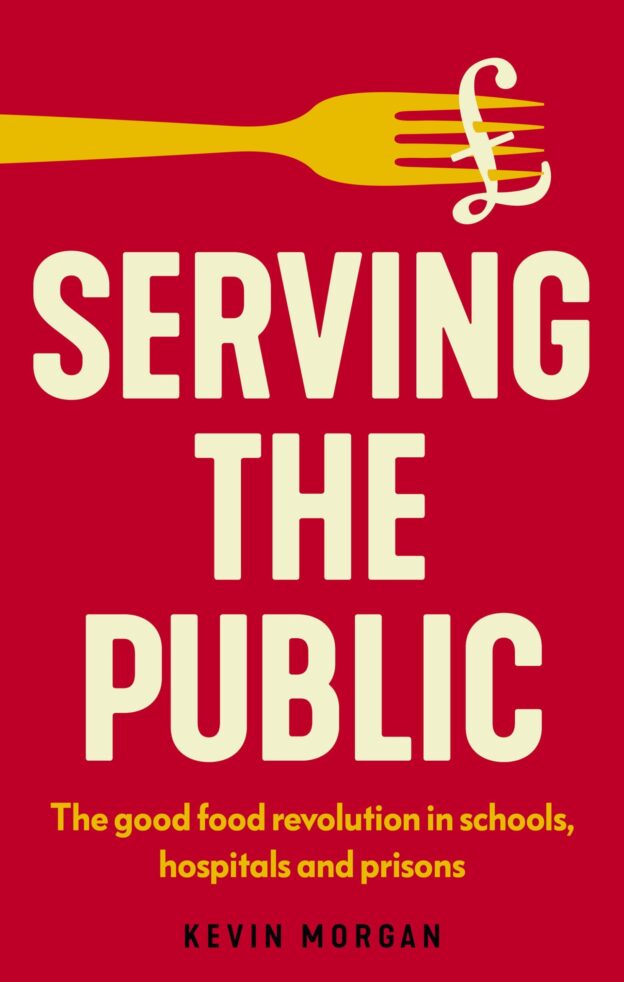
In his book Serving the Public, Kevin Morgan focuses on the food supply to public institutions—specifically, schools, hospitals and prisons in the UK and the USA. In these institutions the characteristics of food insecurity—namely, inadequate access to healthy food—are particularly pronounced, leaving their mark on both global and local food systems. In many schools in the UK and the US where meals are provided, the nutritional value of the food is limited and, in some cases, even detrimental to the pupils’ balanced biological, neurological and psychological development. Students from economically fragile families are especially at risk in such contexts. The meals provided by many schools—if any are provided at all—are unlikely to be supplemented at home by nutritionally balanced meals, as is generally the case in more prosperous households. Yet even in many of these better-off families, fast food or ready-made meals purchased at a supermarket have increasingly replaced healthy, home-cooked meals.
In general, every hospital and prison—theoretically at least—treats all its residents equally. The lack of a balanced diet affects all patients or inmates, albeit for different reasons. Key factors include limited budgets, institutional value systems that prioritize cost-saving over nutritional quality, the lack of food-conscious staff, and centralized public administrations that impose top-down decisions on whether innovative initiatives can be launched, maintained, etc.
Although Professor Morgan makes a sharp analysis of the failing provision of meals in schools, hospitals and prisons, with very detailed empirical data, he is not a doomsayer. Serving the Public conveys a message that moves far beyond a gloomy picture of food insecurity on ‘the public plate’. He praises successful and promising experiments, emphasizing how they survived or were cut off, especially by top-down decisions, budget cuts, or the departure of social innovators. He analyses the factors that make for success and those that promote resilience, thus providing an instructive platform for future action. He outlines the dialectics of the recovery of good food provision: identification of the various features of the food challenge, brave endeavours for improvement, their success and failure, and the lessons learned to pave the way for the future (policy shifts, more power for local authorities, democratic ways of cooperating between social innovators and state agents …).
The book is organized in three parts. In the first, ‘Reclaiming the Public Plate’, Kevin Morgan situates the food crisis within the poly crisis in which the world currently finds itself. He links the food crisis to the environmental crisis affecting the ecology of various parts of the earth, the geopolitical tensions affecting access to food, the monopolistic strategies of transnational corporations (TNCs) dealing in food, the predominance of neoliberal governance recipes for public management (leaving the public plate to market allocation), and the diminishing impact of well-meaning international organizations such as the United Nations and the Food and Agriculture Organization, insofar as they themselves are constrained or intimidated by TNCs. He examines initiatives to rehabilitate the state and have it take up its authentic role of serving the public. To this end, public procurement policy should adopt a multi-value perspective (and not just that of economic efficiency), and a devolution of political power should be implemented.
The second part, ‘Schools, Hospitals and Prisons’, looks at the state and future of ‘the public plate’ in these institutions. In schools, for example (chapter 2), Morgan examines three models of school food provisioning against the background of the history of the British school meal service. He shows how changes in the political landscape and the performance of state institutions have a significant role in fostering such models. He concludes the chapter by looking at what he calls foodscapes of hope: Malmö in Sweden, as well as:
The Universal Free School Meals Movement, in which Scotland, Wales and some London boroughs have launched universal free school meals schemes for all primary school children, heralds one of the most important social policy innovations in the history of school meals provision in the UK (p. 69).
‘Foodscapes of Hope’ are specifically documented in the third part of the book, with a particular focus on the Good Food Movement in the UK and the USA. The movement is built on local food initiatives, triggered by a combination of local factors—such as reactions to the noxious impact of the industrial food system, as well as the resilience and proliferation of small-scale initiatives—and global factors such as international frameworks like Agenda 21. Many of the local food initiatives are now affiliated with the Sustainable Food Places network, which Morgan identifies as the main forum for local food movements in the contemporary UK (p. 184).
A message in a bottle
This is a rich and highly engaging book, strengthened by the author’s commitment to both academic rigour and public-oriented scholarship. His capacity to weave together theoretical development with grounded empirical research makes the work particularly valuable for understanding the evolving roles and future trajectories of food insecurity in cities and regions in the UK and US. In doing so, the book speaks to central concerns within global urban studies and urban–regional research more broadly, including the politics of welfare infrastructures, uneven urban conditions, and the socio-spatial dynamics shaping food systems.
There is, however, a minor yet notable limitation that emerges from the book’s geographical focus. Although Malmö and Sweden provide compelling examples of what ‘foodscapes of hope’ in other countries can look like, the almost exclusive attention to the Anglo-Saxon context risks narrowing the comparative frame. My own experience observing public-sector food initiatives elsewhere in Europe gave me the sense of reading this book, at times, as a somewhat displaced European.
So my small ‘message in a bottle’ drifting across the North Sea is this: the book might have gained additional depth had it considered the wealth of public food practices unfolding in other European settings. Across the continent, various alternative food networks and public food programmes are reshaping the public plate in schools, hospitals and other institutions—often grounding their work in local or regional supply chains.
Italy offers one such example: national legislation promotes regional sourcing and organic ingredients, and nearly 60% of local authorities purchase organic food for school meals. Studies also show that Italian menus broadly follow Mediterranean diet principles and embed sustainability priorities such as ‘more plant foods, less meat and reduced food waste’. Equally important is attention to the meal experience itself, with many primary schools serving three-course lunches at shared tables, often with teachers present, and with subsidies to ensure broad access. While unevenly implemented, these practices illustrate how public institutions can shape healthier, more sustainable foodscapes under different political and cultural conditions.
This example suggests that the Swedish case explored in the book sits within a wider European field of experimentation in public food provision. My ‘message in a bottle’, then, is simply an invitation to consider how the book’s insights might speak to, and be enriched by, these other experiences. Broadening the comparative lens would only strengthen what the book already achieves so well: showing how local, regional and national institutions can create genuine ‘foodscapes of hope’ within the everyday infrastructures of urban and regional life.
Frank Moulaert, KU Leuven
Kevin Morgan 2025: Serving the Public. The Good Food Revolution in Schools, Hospitals and Prisons. Manchester: Manchester University Press
Views expressed in this section are independent and do not represent the opinion of the editors.