
From Chongli’s Olympic slopes to China’s borderlands, villages and platform cities, IJURR’s new virtual issue charts emerging directions in urban China research
Even if you’ve never been to China, you have likely encountered extensive discussion of its largest cities in this journal and elsewhere. China’s first-tier cities—Shanghai, Beijing, Shenzhen, Guangzhou and Hong Kong—dominate economic life, political authority, technological innovation and cultural production, and they have accordingly attracted disproportionate scholarly attention. Far fewer readers will be familiar with places such as Huizhou, Chongli, Khorgos, Lijiang, Jiyuan or Shenyang—second-tier cities and small towns that have appeared in IJURR publications in the last two years. Yet while the “big five” absorb most anglophone research on urban China, only 6 percent of China’s population lives in these five cities. The focus on the largest cities represents a significant bias in the field—one that warrants redress.
In addition to this geographic skew, the urban China field has long been organized around a relatively narrow set of themes: (1) land and housing markets, (2) governance and local entrepreneurialism, (3) migration, (4) the environment and (5) the cultural economy. These areas have yielded important insights into China’s urban transformation, yet they leave many urban processes and places underexamined. As China’s urbanization enters a more differentiated and uneven phase, it is increasingly clear that analytic frameworks centered primarily on megacity dynamics and the political economy of land and housing are no longer sufficient on their own.
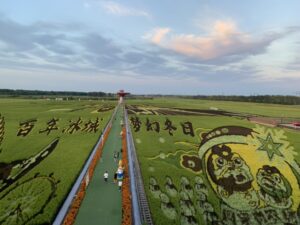
“Rice Field Art“ (稻田画) on the outskirts of Harbin in Northeast China, where multi-colored rice varieties are used to create large-scale images for tourists to take pictures and post on social media.” (Photo: Xuefei Ren)
This virtual issue brings together 16 articles on China published in IJURR during 2024–2025. While not exhaustive of the broader field, the collection highlights notable shifts in current scholarship. Three developments stand out: a widening of geographic focus, diversification of thematic concerns and a broadening of authorship.
First, the geographic scope of recent research has expanded markedly. Seven articles examine the “big five” cities, while the remainder engage with small towns, villages and borderland regions. These include analyses of Chongli, a ski resort area redeveloped for the Beijing 2022 Winter Olympics—where star athlete Eileen Gu won gold and silver in freeski events; Lijiang, a tourist city with a UNESCO designation in the southwest; Khorgos, a Sino-Kazakh border hub in Xinjiang in the far northwest; and Shenyang, the heartland of China’s northeast rustbelt that has seen a cultural renaissance. Such peripheral cities and towns draw attention to forms of urban change that unfold outside the metropolitan mainstream and complicate dominant narratives of Chinese urbanism.
Second, the thematic landscape has diversified. Emerging lines of inquiry include digital platforms (Xiaohongshu, Taobao, WeChat), regulatory ambiguity, rural revitalization and neighbourhood governance. Established themes have also taken new directions—through studies of socialist-era housing retrofits, state-backed venture capital, and the evolving roles of environmental NGOs in the era of “ecological civilization.” Together, these contributions signal an expanding analytical repertoire in the study of China’s urban present.
Third, authorship has broadened significantly. In addition to long-standing centres of expertise in Hong Kong and the UK, this virtual issue features contributors based in Europe, Australia, Singapore, Korea and a diverse range of mainland Chinese universities, including many early-career scholars. This diffusion of research sites and institutional affiliations reflects the increasingly global and multi-sited character of urban China scholarship.
We invite readers to explore this virtual issue and engage with the emerging agendas it brings into view. Collectively, these articles document the multiplicity of urban trajectories unfolding across China and illustrate how scholarship on Chinese urbanization is evolving—conceptually, empirically and geographically.
IJURR Editorial Board Member
ARTICLES (free to access for 90 days)
Borders and Border Regions: Frontiers, Identity and Shadow Governance
Ngo, Tak-Wing, and Eva P.W. Hung. 2024. GRAY GOVERNANCE AT BORDER CHECKPOINTS: Regulating Shadow Trade at the Sino-Kazakh Border.
Chen, Pinyu, Kaj Zimmerbauer, Ruyu Tao, and Xiang Kong. 2024. PHANTOM REGIONS WITH PENUMBRAL BORDERS: Discussing the Palimpsest Spatialities and Hybrid Identities of Huizhou Region, China.
Mascaro, Giorgia. 2024. HERITAGIZATION AS AN AUTHORITARIAN URBAN PRACTICE IN CHINA: Insights from Lijiang.
Urbanizing Mountains and Villages: Urban-Rural Entanglements
Theurillat, Thierry, and Mengke Zhang. 2024. FINANCIALIZED GREEN STATE ENTREPRENEURIALISM AND THE URBANIZATION OF MOUNTAINS: Chongli’s Consumption-based Territorial Business Model for the 2022 Beijing Winter Olympics.
Santi, Ettore. 2024. STATE-LED RURALIZATION AND ITS URBAN ENTANGLEMENTS: Agribusiness Land Transfers in Rural China.
From Xiaohongshu to Wechat: Place-Making in the Platform City
Cao, Liu. 2025. THE POLITICS OF WANGHONG CONSUMPTION: (Re)Making the Place through New Urban Aestheticisation.
Fayard, Gregory. 2025. STREETS AS STAGES: Traffic Enforcement and the Competition for Cultural Growth in China.
There Goes the ‘Neighborhood’
Wang, Ying, Fulong Wu, and Fangzhu Zhang. 2025. STATE BUILDING IN CRISIS MANAGEMENT: Reflections on Statecraft from the Shanghai Lockdown.
Gerlofs, Ben A., and Kylie Yuet Ning Poon. 2025. STATES OF COMPULSION: Reassessing ‘State-Led’ Neighborhood Change in Hong Kong.
Fifty Shades of Entrepreneurialism
Zhang, Lin, and Tu Lan. 2025. INNOVATING URBAN CHINA: The Rise of the Local Venture State and the Making of New Entrepreneurial Spaces.
Zhang, Yong. 2024. THE PARTNERSHIP QUESTION AS A SCALE QUESTION: Extending the Theorization of Entrepreneurial Urbanism in China.
Housing & Land in Flux: From Finance to Elevators
Li, Yunjing, and George C.S. Lin. 2025. UPLIFTING URBAN DEVELOPMENT THROUGH REVITALIZATION (PANHUO): ‘Living’ Legacy of Socialist Housing in China’s Sustainability Transition.
Seo, Bo Kyong, and Dayoon Kim. 2024. THE HOUSING-WELFARE REGIME AND THIRD-SECTOR HOUSING IN HONG KONG AND SOUTH KOREA: A Historical Institutionalist Perspective.
Xu, Nannan. 2024. CHINA’S LAND FINANCE AS ACTIVE MODE OF LAND DEVELOPMENT AND INFRASTRUCTURE DELIVERY: Reality, History and Prospects.
Parentocracy, Migrants, and Schools: Educational Inequality
Zhang, Yuqing, and Hyungchul Chung. 2025. POLICY-CONSTRAINED PARENTAL CHOICE AND SCHOOL DISTRICT SEGREGATION: Evidence from Local and Migrant Families in Suzhou, China.
Governing Urban Natures
Liang, Luquan, Jennifer Day, and Sun Sheng Han. 2024. MOTIVATIONS OF CITIZENS AND ENVIRONMENTAL NGOS: Co-Producing Urban Greenspaces in Beijing.