
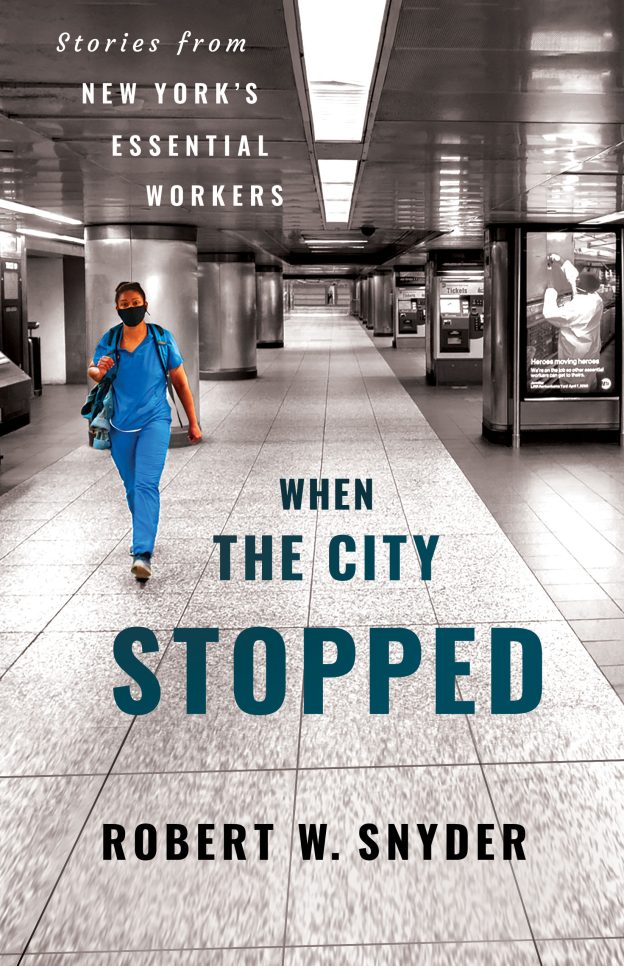
Many readers may initially feel reluctant to engage with yet another book on Covid-19, wishing instead to forget the pandemic and its affective traces—from visceral discomfort at breached distancing rules to anxiety induced by crowded public spaces. Yet this book demonstrates why such reluctance is misplaced. Through the voices of New York’s essential workers, it offers a dense oral history of one of the pandemic’s main epicentres. It presents the stories of essential workers against the backdrop of decades of neoliberal development, which had already weakened public health infrastructures and exacerbated social and spatial vulnerabilities long before the virus arrived. The result is a portrait of a city entering the pandemic in a highly exposed state: hospitals, especially public ones, were quickly overwhelmed; protective equipment remained scarce; and healthcare professionals were faced with the impossible decision of which lives to save. Overall, the book captures impressively how the pandemic deepened pre-existing racialized, gendered and class-based inequalities, visible in overcrowded housing, differentiated possibilities for remote work and uneven mortality rates across neighbourhoods and ethnic groups.
Importantly for urban research, the narratives illuminate how neighbourhood organizations, community leaders and spontaneous rituals such as collective evening applause restitched a sense of community and solidarity at a time when death, fear and isolation dominated the urban sensorium. Simultaneously, the author also mentions self-interest, profiteering and the fraying of social trust caused by the pandemic. Overall, the book insists on the need to remember the pandemic experiences rather than move on too quickly. In doing so, it not only documents a specific urban conjuncture but also raises urgent questions about whose labour, lives and deaths count in the governance and imagination of post-pandemic cities.
The book is organized chronologically, which helps to maintain narrative focus across a heterogeneous set of testimonies. It opens with an introduction by the author and finishes with his conclusion. In between, there are six chapters, each of which begins with an introductory comment to set the scene. This is followed by contributions from urban essential workers in various professions, offering insights into their challenging everyday lives during the pandemic. While most of these contributions are based on oral history interviews, other forms were also used, such as diary entries, poems and a pandemic encyclopaedia written by high school students. The book’s structure, along with the accompanying photos and figures, enables readers to move between everyday experiences and wider political developments, from the early spread of the virus and vaccine rollout to shifting public health guidelines.
The narrative follows people as they assume shifting roles in the epicentre of the pandemic, such as teachers who not only navigate inadequate digital infrastructures when supporting children online but also disseminate information about food banks. Vivid accounts from hospitals and other essential spaces show attempts to protect loved ones and strangers amid pervasive fear of dying alone, disrupted mourning rituals and the psychological strain of mass death. At the same time, constantly changing regulations, opaque communication and punitive enforcement practices generated deep insecurity, particularly for small business owners such as restaurant operators who struggled to understand and comply with evolving rules.
The book situates its analysis within wider political developments, including the murder of George Floyd and the ensuing Black Lives Matter protests, to trace the interplay between mass mobilizations, vaccine availability and the bureaucratic challenges of registration systems. It illustrates how these dynamics intersect with entrenched structural inequalities, rendering access to protection particularly precarious for older, economically disadvantaged and otherwise marginalized residents. In the conclusion, the author issues a compelling call for renewed solidarities that transcend familial, social and political boundaries, contending that the cultivation of collective capacities—through, among other things, the revitalization of trade union activity—is vital to fostering a more caring urban future and to drawing critical lessons from both the shortcomings and accomplishments of pandemic responses. As Clifford Pearsson poignantly remarks, ‘if we become a more just and humane society as we stumble forward, all the pain we are currently experiencing may be worth it’ (p. 211).
One of the text’s strengths lies in the diversity of styles and voices across its chapters. The glimpses into the essential workers’ daily lives during this exceptional period are engaging and evocative, often leaving the reader wanting to know more. However, for readers unfamiliar with the New York context, the book might have benefited from additional background information, such as a city map, short descriptions of neighbourhoods or explanations of local health-sector terminology and the abbreviations used. Although the volume has listed all portrayed workers, it is not conceived as an edited collection. The featured contributors are named, yet not credited as co-authors, which raises questions about authorship and editorial transparency. Ethical aspects also arise. It remains unclear how the participants were informed and in what way they consented to their materials being included in this publication. Despite the commendable diversity of perspectives, the selection of voices seems somewhat circumscribed. Strongly anti-state or conspiracy-oriented viewpoints, for example, are absent, though their exclusion is never addressed in the editorial texts. Similarly, the title seems slightly misleading—many of those portrayed continued to work, meaning the city never completely stopped. Furthermore, the terminology used oscillates between essential workers and frontline workers, the latter term carrying distinctly militaristic connotations whose use remains unexplained.
Overall, the book represents an exceptional contemporary document that captures both the immediate experiences of the pandemic and the broader social and political fractures it exposed. It includes a wide range of voices—across age, race, class and profession—and notably features non-binary persons. Yet men remain disproportionately represented. The extensive contextual introductions preceding each chapter provide valuable explanations of political and social developments, offering thoughtful framing for readers. This makes the book not only relevant for scholars of urban studies, sociology, geography, anthropology and public health, but also for students and a general readership. As time passes, such testimonies will only grow in significance.
Carole Ammann, University of Lucerne and ETH Zurich (affiliated researcher)
Robert W. Snyder 2025: When the City Stopped. Stories from New York’s Essential Workers. Ithaca, NY, and London: Three Hills.
Views expressed in this section are independent and do not represent the opinion of the editors.