
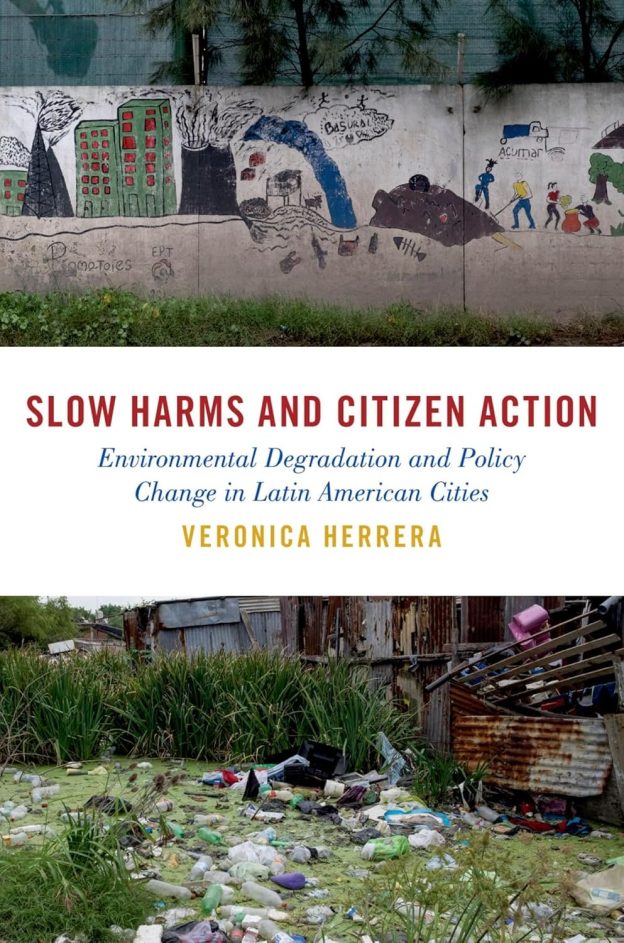
In her most recent book, Slow Harms and Citizen Action: Environmental Degradation and Policy Change in Latin American Cities, Veronica Herrera offers a persuasive argument about the existing connection between civil society mobilization and emerging environmental policies in Latin American urban centers. The book is built on a comparison of three national capitals—Buenos Aires, Bogotá, and Lima—and their experiences with toxic pollution in rivers.
She characterizes the dire consequences arising from river contamination as ‘slow harms’, as a way to differentiate from other forms of environmental damage that can be understood as more immediate and sudden, such as natural disasters. For the author, the specific nature of slow harms—building gradually and invisibly across time—generates a particularly pernicious type of policy problem because its impacts can be harder to detect, leading to uncertainty regarding possible claims and solutions.
Its pervasiveness in global South cities makes it a necessary and valuable object of investigation for environmental and urban policy studies. Despite its concealed nature, river pollution is positioned as an ever-increasing issue, with a notable connection between water contamination and the rising rates of disease, from diarrhea to cancers, causing a disproportionate number of avoidable deaths in middle and low-income countries. In addition, ‘slow harms’ are understood as inherently linked to processes of urbanization in the global South and Latin America—marked by rapid growth, informal settlements and spatial segregation, as well as economies dependent on polluting and extractivist industries.
From a research design perspective, the adoption of a case-study framework focused on Latin American cities contributes to what has been called a recent renaissance of comparative approaches in the field of urban studies, serving as a tool for innovative empirical investigation and theory-building. In this regard, the methodological choice made by Herrera of favoring process-tracing proves well suited to the development of within-case explanations that are later on contrasted across the examined cities.
The overarching argument of the book is centered around two concepts—‘bonding mobilization’ and ‘bridging mobilization’—which, in combination, are pointed to as the main explanatory factor behind the successes of slow harms remediation policies. The first concept derives from social capital theory, as presented by Granovetter and Putnam. Herrera identifies that impacted communities in Buenos Aires and Bogotá have been able to articulate at a grassroots level due to preexisting strong ties that enable what she calls ‘bonding’.
However, bonding mobilization alone proves to be insufficient for impactful policymaking because, as the author points out, ‘impacted communities are often underresourced and claims are frequently fragmented across large territories’ (p. 15). For instance, in the Colombian case, we see that environmental activism remains limited to small initiatives, impeding the scaling up of demands. Therefore, in addition to grassroots organizing, bridging mobilization requires that actors with relevant resources aggregate and connect territorially based grievances and bring them to the attention of the state. Bridging actors can be found in civil society or within the state itself, in the form of bureaucrat-activists.
For Herrera, their power to act as bridges emerges from a capacity to link ‘slow harms’ to a more ‘unifying set of ideas’ that can achieve ‘broader resonance’ (p. 133). In the case of Buenos Aires, Argentinian NGOs and state officials framed pollution as a human rights violations issue which enabled them to draw upon a common past and shared language regarding the centrality of human rights, itself a product of the national struggle for democracy and against the military dictatorship.
In the development of the book’s argument, Herrera reveals a configurational perspective of causality. The identified outcomes in each city are presented as the results of a combination of interacting variables: the presence or absence of bonding and bridging mobilization, in conjunction with certain ‘enabling conditions’. For instance, the political ideology of the governing national party seems to affect how it will receive social environmental claims. In Argentina, a continuity in leftist administrations has created institutions that are more open to civil society demands. In contrast, in Colombia and Peru, conservative ruling parties have been historically wary of human-rights and environmental NGOs and have favored the interests of extractive industries, such as mining.
In summation, Herrera’s argument is profoundly relational: policy ideas, instruments and strategies for tackling water pollution are directly shaped by the interactions between social and state actors, working across different levels and territories.
By articulating the concepts of bonding and bridging mobilization, the author provides an interesting insight about the conditions under which networked arrangements can be more conducive to the dissemination and scaling up of policy issues and ideas. It is an argument that can be appropriated in debates regarding policy networks, policy communities, advocacy coalitions and other forms of examination of socio-state interaction.
Also, the book hints at a multilevel governance understanding of urban environmental issues, in which policies are a product of disputes between private, public and civil society actors working across jurisdictions. In this depiction, the successes or failures of demands regarding slow harms depend on the capacity of actors to form coalitions and to engage different institutions within the state, for instance the judiciary branch, as seen in the Argentinian case (and in the Colombian case, to a smaller degree).
However, in its multiscalar framework, Herrera provides significantly less attention to the role of municipal governments and urban actors, in contrast to the national level. For instance, it remains unclear if and how local politics influence policy responses to the problem of river pollution.
Nevertheless, Herrera presents an overall convincing thesis that contributes to contemporary fields of research at the intersection of urban studies and political science. The study makes a strong claim regarding the importance of better incorporating the analysis of societal forces in the examination of environmental policy topics, an approach that can prove valuable to other objects of interest such as urban climate change governance.
Alexandre Fontenelle-Weber, University of São Paulo
Veronica Herrera 2024: Slow Harms and Citizen Action: Environmental Degradation and Policy Change in Latin American Cities. New York: Oxford University Press.
Views expressed in this section are independent and do not represent the opinion of the editors.