
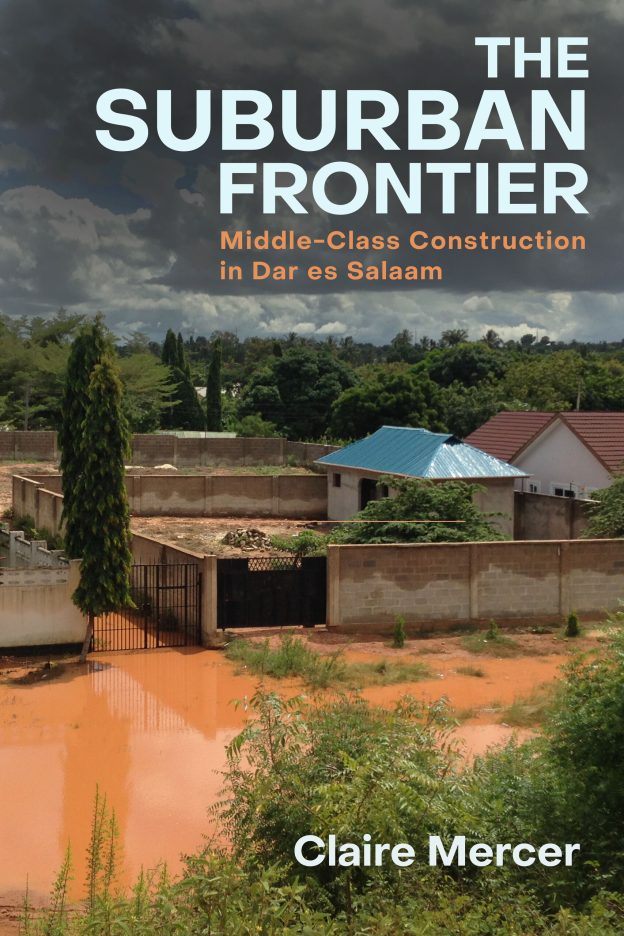
Africa is undergoing a profound transformation, as widely reported in international media and confirmed by demographic and economic data. Rapid urbanization and the expansion of the middle classes over recent decades constitute two central dimensions of these social and economic changes. Published in 2024, The Suburban Frontier: Middle-Class Construction in Dar es Salaam offers a timely and insightful account of how these two processes are deeply intertwined. The book advances a spatial understanding of middle-class formation, arguing that investment in land, housing, and landscapes is a key driver of both class-making processes and the future trajectories of African cities. The Suburban Frontier is written by Professor Claire Mercer, a leading human geographer in African studies, and draws on more than twenty years of research in Tanzania, including systematic fieldwork in Dar es Salaam between 2012 and 2018 and over 200 qualitative interviews conducted with a wide range of suburban residents across social classes, as well as state officials, community groups, planners, and politicians. Anchored in rich empirical evidence, the work shows how middle-class house-builders, through the self-construction of their homes and neighbourhoods, not only shape the city and extend the suburban frontier, but also actively produce middle-classness. They are treated by Tanzanian land law as ‘occupiers’ of the land, but Mercer’s research shows how their own perspective differs markedly from that of state agencies:
The middle classes think of themselves as developing the land. They build bespoke homes for their families, clear and maintain access roads, plant or erect and maintain boundaries, and bring water and electricity to their plots … they have found, bought, staked out, enclosed, built, maintained, and developed their own private property. Property has become a ‘state of mind’, an embodied practice and a shared set of experiences and interests among middle classes. Middle-classness is deeply implicated in the making of property on the suburban frontier (p. 19).
Across its six chapters, the book reveals the suburban frontier as a dynamic and contested space, shaped by overlapping processes of dispossession, racialization, commodification, risk-taking, aspiration, and slow property accumulation. Chapter One, ‘Groundwork: The Coloniality of Space’, and Chapter Two, ‘The Suburban Frontier’, examine how property relations and social differentiation in Dar es Salaam were historically produced through colonial and postcolonial land regimes. Mercer shows that under German and British rule, land rights were systematically alienated from African populations on the basis of racialized assumptions that Africans were unsuited to urban life and properly belonged to rural ‘tribes’, while Europeans were associated with the city. These assumptions were institutionalized through colonial urban planning, which divided the city into three racially differentiated zones: Uzunguni, reserved for Europeans; Uhindini, a mixed residential and commercial area largely dominated by the Indian community; and Uswahilini, where African residents were confined to poorly serviced areas and constructions using local materials. Mercer argues that this colonial spatial order laid the groundwork for the later expansion of the suburban frontier and its consolidation in the Tanzanian post-socialist period.
Following independence in 1961, the socialist government largely retained British land laws, introducing continuity rather than rupture. All land was declared public and placed under presidential control, a framework that facilitated the emergence of a bureaucratic bourgeoisie that came to dominate high-value urban residential property in Dar es Salaam. At the same time, the expansion of the civil service and industrial production fostered the rise of an educated middle class positioned between this elite and workers and peasants and seeking access to urban land. It was in the suburban frontier that this group found, during the economic liberalization of the 1980s and 1990s, a means of establishing a durable presence in the city. Together, these colonial and postcolonial processes shaped the city’s spatial form and entrenched enduring patterns of inequality and social differentiation structured by race and class. From past to present, the coloniality of space remains central to middle-class urban imaginaries and spatial practices.
Chapter Three, ‘Land’, demonstrates the centrality of land to middle-class practices of saving and investment. Acquiring land serves as a means of storing value in a cash-oriented economy, avoiding rent payments to landlords, and generating income through rental properties. As an asset, land constitutes a key resource in the reproduction of middle-class projects oriented towards family futures and children’s inheritance. However, regularizing and securing property ownership on the suburban frontier of Dar es Salaam is a lengthy and risky undertaking, marked by legal ambiguity and significant financial and temporal uncertainty, and requiring technical expertise and personal connections beyond the reach of many Tanzanian citizens.
The following three chapters—‘Landscape’ (Chapter Four), ‘Domestic Architecture’ (Chapter Five), and ‘Lifestyle’ (Chapter Six)—offer a detailed examination of middle-class everyday life through a careful analysis of boundary-making practices, showing how the coloniality of space is reproduced in the aesthetic politics of the suburban landscape. Despite sustained efforts at distinction, however, middle-class house-builders lack the means to secure the suburban frontier against the urban poor of the unplanned city. They also lack the capacity to guarantee either the steady cash flow or the skilled labour required for an endless process of house construction and experimentation. As a result, they inhabit a permanently unfinished suburban fabric and a liminal condition, oscillating between aspiration and disappointment, characteristic of middle-classness. From their ‘not-quite-as-imagined’ houses, middle-class builders both construct the suburban frontier and are, in turn, shaped by it. While Mercer’s analysis foregrounds the social, legal, and aesthetic dimensions of this process, it also invites further reflection on the environmental implications of suburban expansion, which remain largely implicit in the account.
I read The Suburban Frontier in João Pessoa, a city known for its paradisiacal beaches and increasingly framed as a newly ‘discovered’ coastal frontier, following the intensive exploitation of more established sites along Brazil’s eastern seaboard, such as Rio de Janeiro, Salvador, or Fortaleza. Reading the book from this vantage point gave Mercer’s analysis a wider resonance. João Pessoa—and neighbouring Cabedelo, a distinct municipality that nevertheless functions as a suburban extension of the city—is currently undergoing rapid transformation, with new residential developments advancing over land that remained largely unbuilt until the mid-twentieth century, following intense urbanization from the 1980s onwards and a recent surge in property prices. These dynamics echo the processes Mercer describes, suggesting that the suburban frontier she analyses is not a localized phenomenon but a recurrent feature of urbanization in postcolonial cities. At the same time, reading Mercer from this context points to the value of further transnational research that brings analyses of middle-class suburbanization into dialogue with Latin American urban theory, including Kowarick’s concept of urban spoliation, in order to better capture how aspirational projects of distinction are entangled with broader processes of uneven urbanization and dispossession, as well as their profound environmental consequences. Read in this light, the book speaks to a broader audience concerned with uneven urban growth, aspirational middle classes, and the enduring colonial logics that continue to shape contemporary urban landscapes, particularly in the global South.
Deborah Fromm, London School of Economics and Political Science
Claire Mercer 2024: The Suburban Frontier: Middle-Class Construction in Dar es Salaam. California: University of California Press.
Views expressed in this section are independent and do not represent the opinion of the editors.